



Nearly a third (29.10%) of UK adults, equivalent to around 16.1 million people, have already turned to AI for financial advice on money, savings or investments. Meanwhile, an almost identical share (30.95%)said they would consider using it in the future, meaning that six in 10 Brits overall would trust AI with their money (60.05%), highlighting a growing appetite for quick and accessible AI-driven financial guidance.
Digital natives lead the charge in trusting AI with their finances
Millennials (aged 25 to 34) lead the trend with over half (53.98%) having already relied on generative AI for financial guidance, followed by Gen Zs (aged 18 to 24) at 46.70%. Usage drops sharply with age, with only 26.95% of 45-54-year-olds using AI for this purpose and less than 10% of those aged 55 and above.
“Adam Nasli, Head Broker Analyst at BrokerChooser said: “AI is increasingly used for financial advice because it delivers instant, easily accessible answers to almost any question, which is particularly appealing to younger generations who often prioritise speed. For many, it also removes the anxiety of discussing personal finances, creating a space that feels judgement-free. But when real money is at stake, AI should always be used to inform rather than decide, and consumers should always rely on trusted, regulated sources for financial guidance.”
One in six people now relies on AI for daily financial decisions
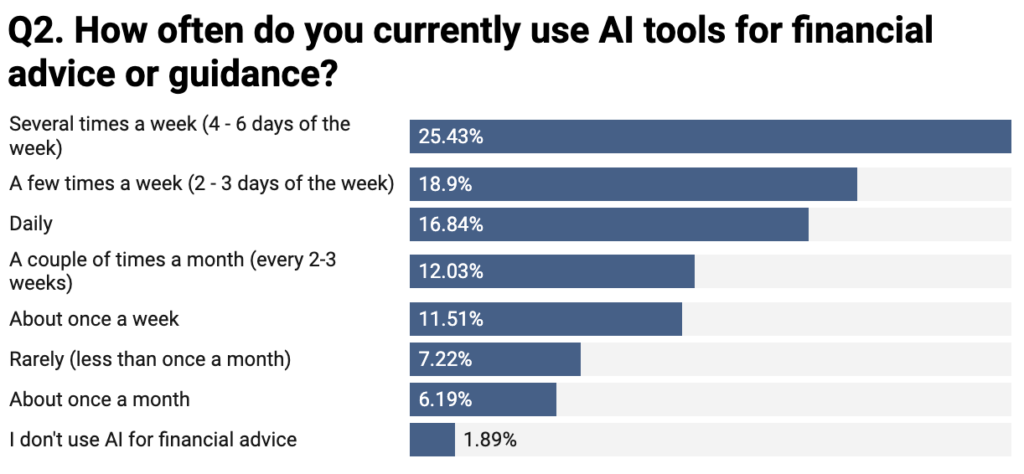
Of those who have used AI for financial advice, the surveyreveals a notable daily reliance, with around one in six users(16.84%), equivalent to approximately 2.7 million UK adults, consulting AI tools every day for their finances.
Daily usage peaks among those aged between 35 and 44 years (21.90%), and adding in a further quarter(25.43%)of UK adults who turn to AI several times a week (four to six days), it’s clear that for many, AI is now part of regular financial decisions. Overall, AI is relied upon for financial decision-making 3.1 days per week on average.
An alarming fifth of UK adults use AI for stock market forecasts
While AI is largely used for low-risk financial tasks – such as finding better savings rates (43.46%), budgeting (38%) and planning financial goals like saving for a house or holiday (33.06%) – usage is also extending into higher-risk territory.
Almost a third of Brits (29.64%) use AI to choose or compare investments, and more than one in five (21.82%) consult AI for stock market forecasts, indicating how quickly these digital tools are becoming trusted advisors for big-stakes financial decisions.
Adam Nasli, Head Broker Analyst at BrokerChooser, commented:
“AI tools can be incredibly convenient for everyday financial tasks like budgeting or comparing savings accounts – but relying on them for stock picking or market forecasts, particularly in fast-moving markets like forex, carries significant risk. These algorithms provide generic guidance based on historical data and patterns, but they cannot fully account for real-time market volatility, geopolitical events or your individual financial situation, risk tolerance and long-term objectives.
Crucially, AI tools are not regulated by the FCA, so they should never be treated as a sole source of financial advice. Use AI for initial insight if you like, but any recommendations should always be verified to apply judgement, adjust strategies, and – most importantly – take responsibility for the guidance received.
Forex markets in particular are inherently complex and highly leveraged, meaning small missteps in decision-making can quickly translate into significant losses. While AI can serve as a valuable supplement, it cannot replace the time necessary to invest into learning to trade and investment strategies. Acting solely on AI advice exposes investors to potentially significant financial losses, with no one responsible for the outcome.”
Alarmingly, over half (52.85%) of Brits are likely to act on financial advice provided by AI tools, according to the survey. Millennials are the most receptive, with more than seven in ten 25 to 34s (76.40%) and 35 to 44s (70.29%) saying they would follow AI’s guidance. In sharp contrast, less than a third of over-55s (30.84%) would consider acting on AI advice.
HENRYs (High Earners, Not Rich Yet) are a high-risk group for trusting AI financial advice
Income also plays a role in financial decision-making, as high earners are the most likely to act on AI recommendations, particularly those with salaries over £75,000 (72.93%). Their financial cushion may encourage confidence in experimenting with AI advice, but it also leaves them exposed to potentially larger losses. The survey demonstrates howhigher incomes tend to correlate with greater financial risk-taking, as mid-income earners (£25,001 – £35,000) are far more hesitant (48.18%).
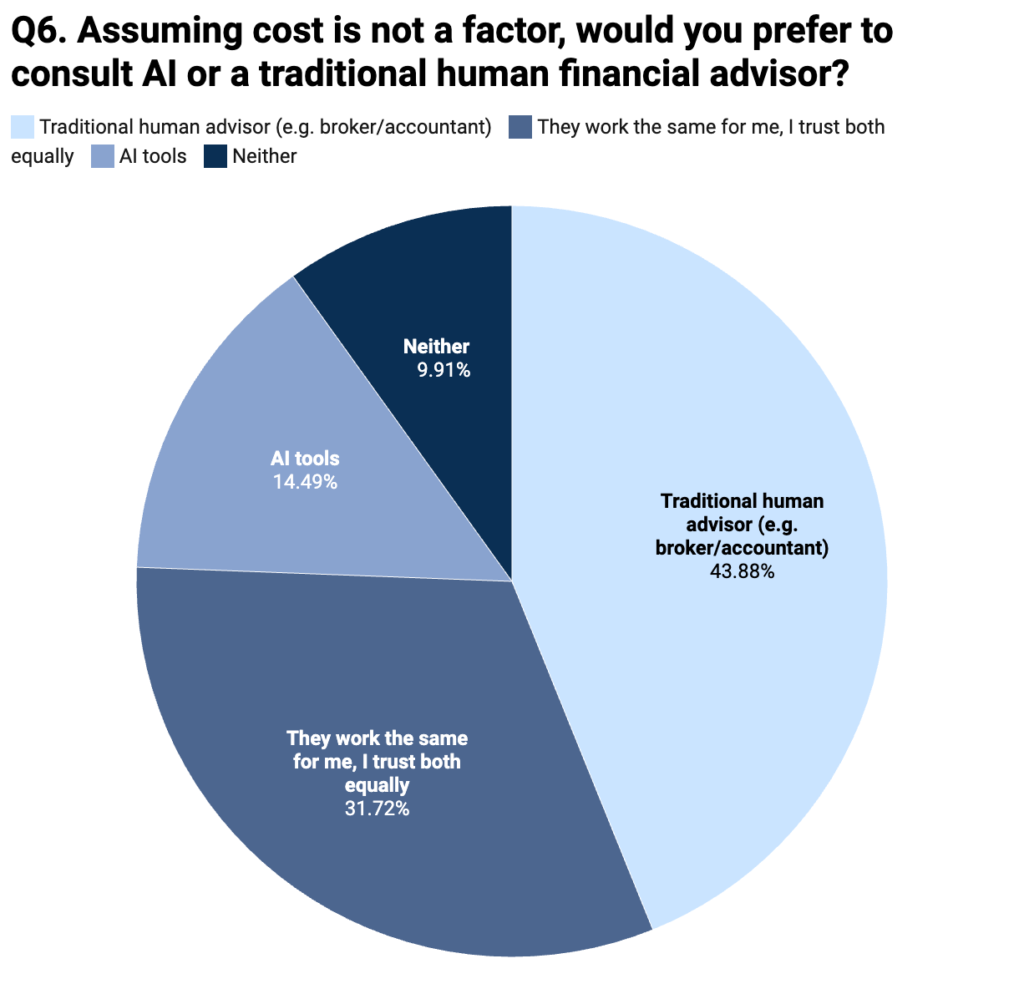
When it comes to choosing between AI and a traditional financial advisor,humans are still in the lead, but the gap is narrowing. Just over two in five (43.88%)Brits would opt for a traditional advisor if cost were no issue.
Older Brits remain loyal to human advice, with nearly 60% of those aged 55 and above preferring a traditional advisor. Confidence in human advice steadily declines with each younger age group, falling to 39.90% among 45 to 54s and 35.71% among 18 to 24s.
Almost one in five Millennials would choose AI over a human advisor
Millennials stand out as the most comfortable with AI managing their finances, with over a third (35.90%) of those aged 25 to 44 believing AI and professional human advisors perform equally well. Notably, a further 16.90% of Millennials would pick AI outright even if cost were not a factor – a sign that adoption may accelerate as digital natives gain financial independence.
View the full survey results, including all six questions and responses here.