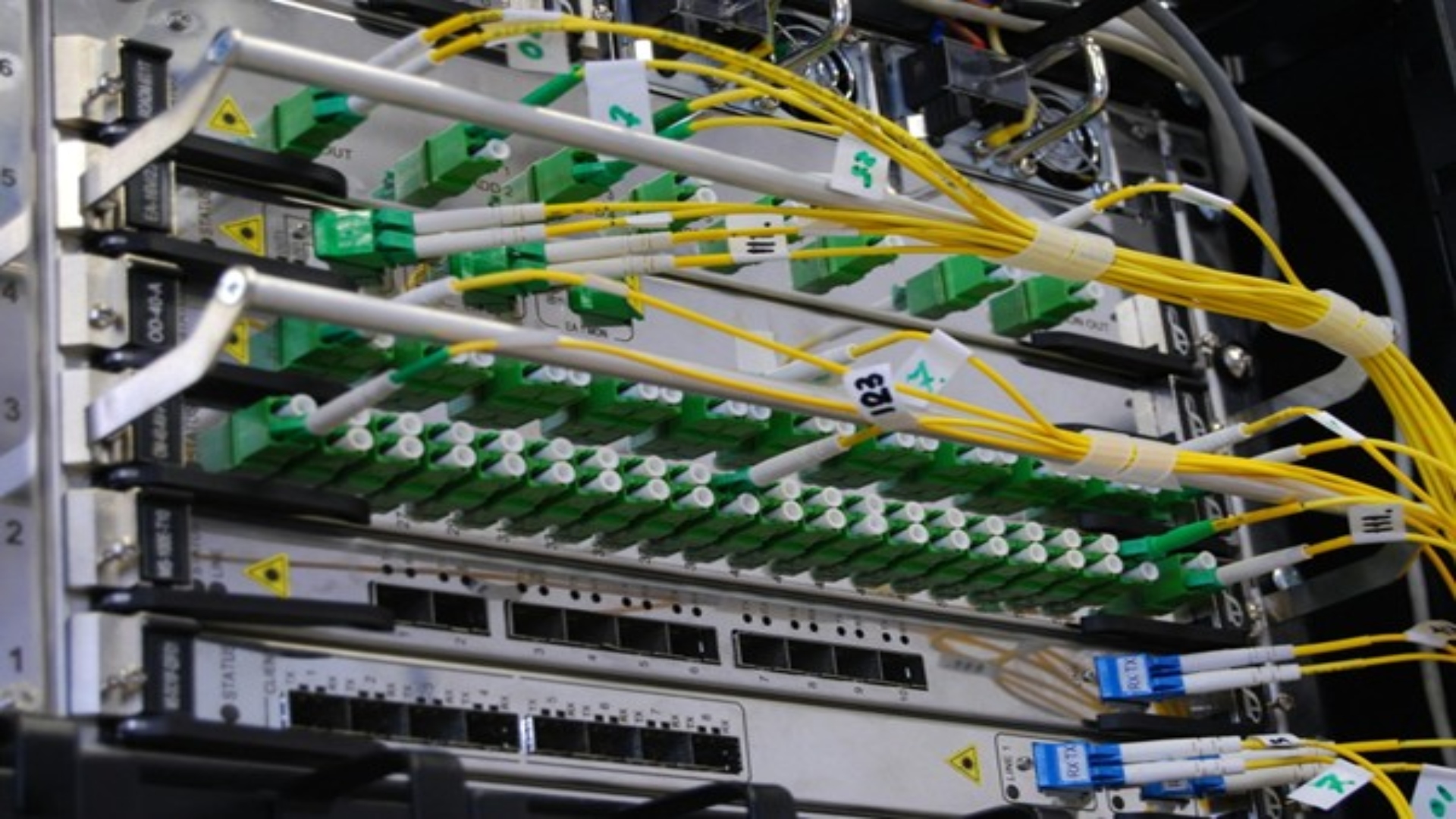



The invisible infrastructure war between microwave and fiber networks is transforming global finance at its core. As trading algorithms grow more sophisticated, the battle for transmission supremacy has become a zero-sum game where nanoseconds determine profitability and network choices dictate competitive advantage.
The Physics of Financial Velocity
Light’s behavior through different mediums creates an unavoidable speed hierarchy. Photons travel 31% faster through air than glass, giving microwave networks an inherent advantage that’s driving resurgence in the microwave radio market. This revival demonstrates how financial infrastructure evolves in cycles—each technological solution eventually meets physical limitations, forcing reinvention of older approaches.
CME data reveals microwave networks now execute 47% of index futures trades during volatile periods despite handling just 28% of overall volume. This discrepancy highlights how latency-sensitive strategies cluster around the fastest available connections when microseconds determine arbitrage success.
Fiber’s Hidden Vulnerabilities
While buried fiber cables project stability, they conceal three critical weaknesses. Fixed routes following existing rights-of-way create predictable bottlenecks where competitors’ infrastructure converges. Microscopic vibrations from distant construction can induce 800 nanoseconds of delay – catastrophic for high-frequency strategies. Repair times stretch into weeks for undersea cables versus minutes for microwave rerouting.
These limitations explain why 83% of Tokyo-London forex traffic now flows through microwave during Asian hours. The Bank of International Settlements reports similar shifts across major currency pairs, with microwave adoption growing 12% annually since 2020.
Microwave’s Technological Renaissance
Modern microwave networks bear little resemblance to their predecessors. Adaptive modulation maintains 99.999% uptime by automatically adjusting to weather conditions. MIMO antenna arrays create redundant signal paths that prevent single-point failures. Quantum clock synchronization has eliminated the timing jitter that once plagued radio transmissions.
The London-Frankfurt corridor demonstrates this evolution – requiring just five relay stations today versus twelve in 2012 while delivering 42% lower latency. Such advances have made microwave indispensable for latency-sensitive arbitrage between European financial centers.
The Market Structure Impact
Faster networks don’t just execute trades quicker – they fundamentally reshape liquidity dynamics. Exchanges colocated with microwave hubs exhibit:
●22% tighter bid-ask spreads during news events
●37% higher message-to-trade ratios
●15% increase in order cancellations
This creates a self-reinforcing cycle where speed advantages attract liquidity, which in turn draws more speed-sensitive participants. The resulting fragmentation raises systemic risk concerns as liquidity becomes concentrated in ultra-fast venues.
The Hybrid Future Emerges
Forward-thinking firms are blending both technologies’ strengths. Fiber handles baseline capacity while microwave bursts carry time-sensitive orders. Predictive routing algorithms forecast volatility to pre-allocate bandwidth. Some experiment with blockchain settlement layers to decouple execution speed from clearing times.
Nasdaq’s quantum-encrypted microwave prototype suggests a future where security and speed converge. Such innovations may eventually reduce the raw speed advantage’s value, shifting competition to other technological vectors.
Regulatory Challenges Mount
Policymakers struggle to address emerging inequities. Spectrum auctions favor deep-pocketed incumbents, while physical tower locations create geographic arbitrage opportunities. ESMA has proposed “speed bumps” for microwave routes, while CFTC debates mandatory fiber backup requirements.
These interventions risk unintended consequences. Artificially leveling the playing field could simply shift advantages to other technological dimensions rather than creating true fairness. The fundamental tension between innovation and access remains unresolved.
The Inevitable Speed Imperative
Financial markets have reached an inflection point where network physics directly influences capital allocation. The microwave versus fiber competition has become the circulatory system of global finance – determining which strategies succeed and which firms fade into irrelevance.
As quantum networking and LEO satellite solutions emerge, this arms race shows no signs of slowing. The ultimate winners will be those who master the art of combining transmission mediums into intelligent, adaptive systems rather than betting on any single technology. In this high-stakes environment, standing still means certain obsolescence.