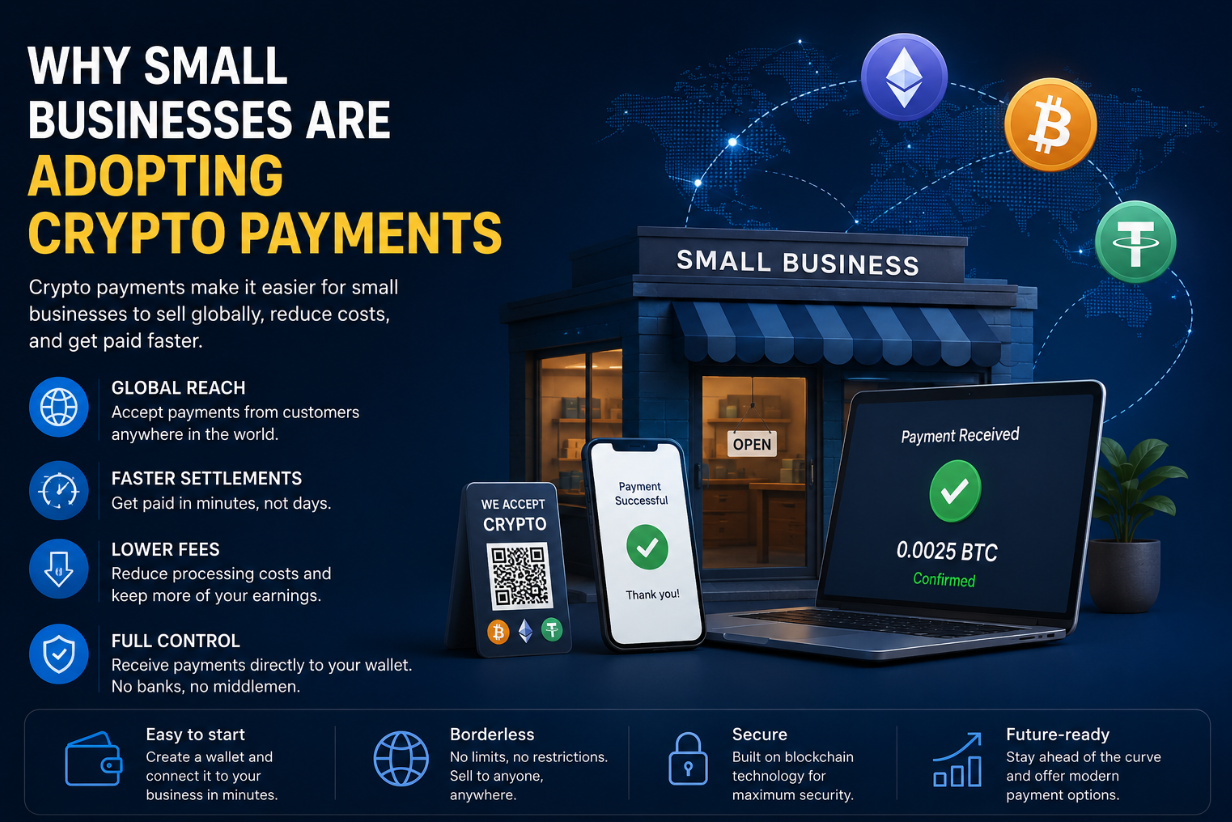


Why Small Businesses Are Adopting Crypto Payments
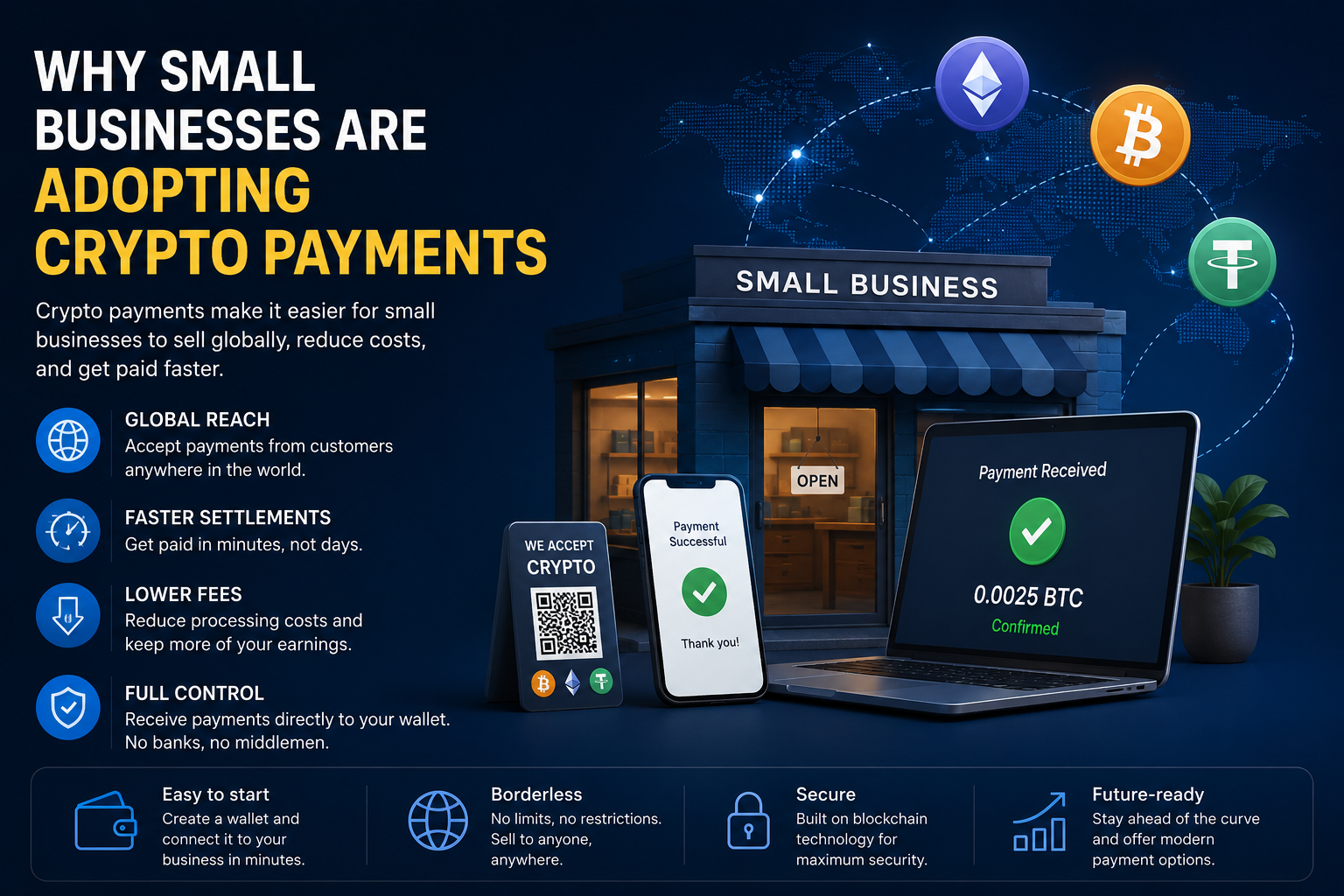
Small businesses are actively adopting crypto payments for their business because it is much simpler and faster than using the banking system with its restrictions and bureaucracy. The process from creating a wallet to connecting it to a business can take as much time as drinking a cup of coffee. Modern e-commerce requires flexible payment infrastructure, and Bcon Global provides a non-custodial payment gateway where merchants receive funds directly to their own wallets without intermediaries or custody risk.
This model is especially attractive for online stores using WooCommerce, OpenCart, or custom APIs, because it removes banking delays and reduces operational friction.
Key advantages for merchants:
- Instant settlement on-chain
- Global customer reach without card restrictions
- No dependency on banking approval cycles
- Full control over funds
What to Look for in a Crypto Payment Gateway
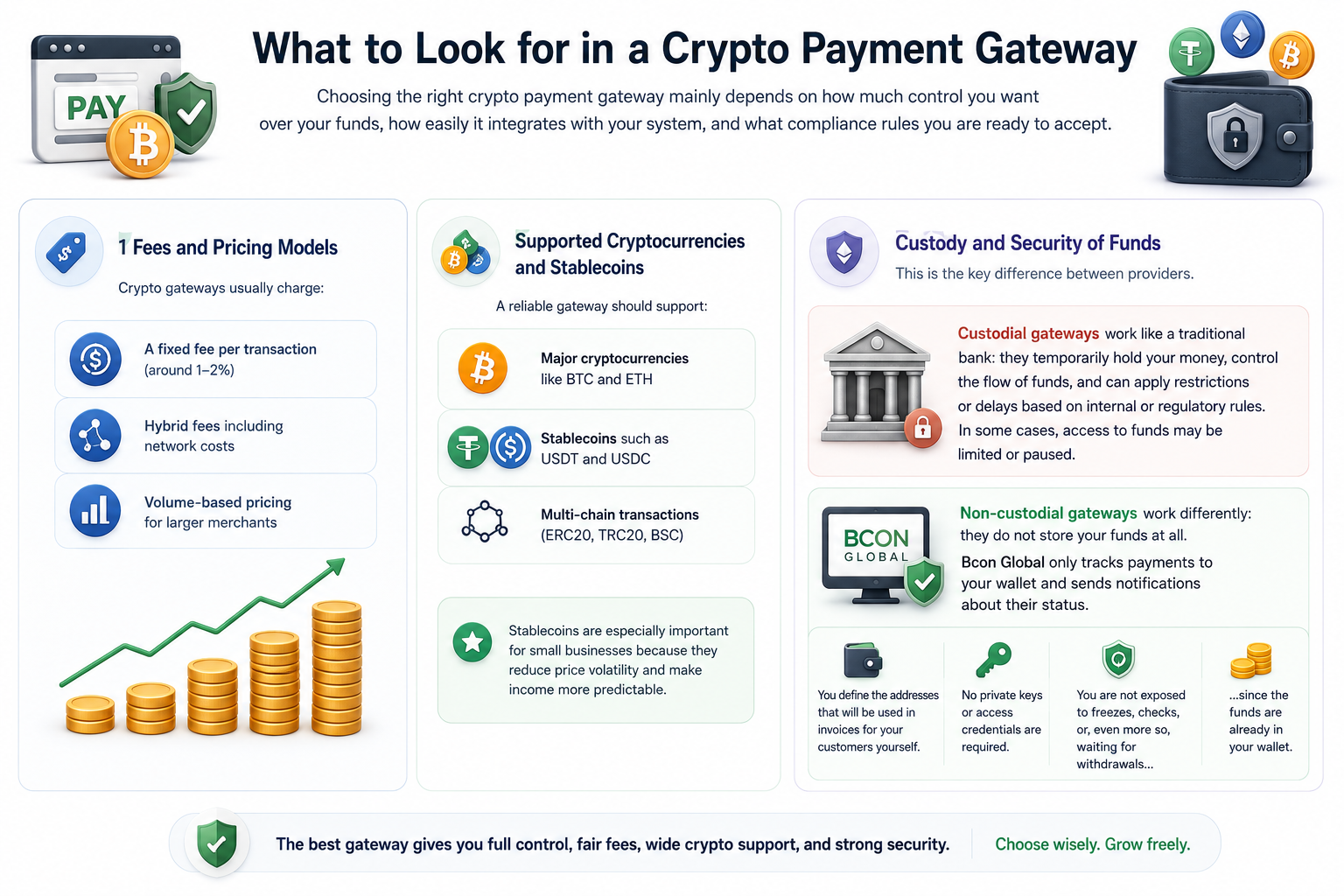
Choosing the right crypto payment gateway mainly depends on how much control you want over your funds, how easily it integrates with your system, and what compliance rules you are ready to accept.
Fees and Pricing Models
Crypto gateways usually charge:
- A fixed fee per transaction (around 1–2%)
- Hybrid fees including network costs
- Volume-based pricing for larger merchants
Supported Cryptocurrencies and Stablecoins
A reliable gateway should support:
- Major cryptocurrencies like BTC and ETH
- Stablecoins such as USDT and USDC
- Multi-chain transactions (ERC20, TRC20, BSC)
Stablecoins are especially important for small businesses because they reduce price volatility and make income more predictable.
Custody and Security of Funds
This is the key difference between providers.
Custodial gateways work like a traditional bank: they temporarily hold your money, control the flow of funds, and can apply restrictions or delays based on internal or regulatory rules. In some cases, access to funds may be limited or paused.
Non-custodial gateways work differently: they do not store your funds at all.
Bcon Global only tracks payments to your wallet and sends notifications about their status. You define the addresses that will be used in invoices for your customers yourself. No private keys or access credentials are required. Because of this, you are not exposed to freezes, checks, or, even more so, waiting for withdrawals, since the funds are already in your wallet.
Top Crypto Payment Gateways Compared
Below is a practical comparison of leading providers and their real-world limitations.
H3: Feature Comparison Table
| Feature | Bcon Global | Coinbase Commerce | BitPay | NOWPayments | CoinPayments |
| Custody model | Non-custodial | Semi / restricted self-custody | Custodial | Hybrid | Custodial |
| Direct wallet payments | Yes | Yes (restricted flows) | No (intermediated) | Yes | Yes |
| Requires KYC | No | Yes (Coinbase account required) | Yes (full merchant + sometimes customer KYC) | Partial / volume-based | Yes |
| Customer payment method | Any wallet | Only supported Coinbase/compatible wallets in some flows | BitPay wallet often required | Any wallet | Any wallet |
| Transaction model | Direct on-chain transfer | Signed transaction / invoice flow | Hosted invoice system | Standard transfer | Standard transfer |
| Payment restrictions | None | Geo restrictions + account dependency | Blocked industries + strict compliance rules | Moderate | Moderate |
| Order status mapping | Advanced customization | Basic | Basic | Medium | Medium |
| JavaScript control | Yes | No | No | No | No |
| API flexibility | High | Medium | Medium | Medium | Medium |
Key disadvantages of competitors (real-world limitations)
Coinbase Commerce
- Requires Coinbase ecosystem dependency
- Limited wallet/payment flow flexibility
- In some setups users must sign transactions via supported wallet flow instead of simple direct transfer
- Regional restrictions and account limitations apply
BitPay
- Full KYC required for merchants and often for customers
- Payments may require BitPay wallet or hosted invoice flow
- Fiat settlement only (no direct self-custody control)
- Strict compliance rules may block certain business types
NOWPayments
- Hybrid custody depending on configuration
- KYC thresholds activate at higher volume
- Some volatility exposure depending on payout method
CoinPayments
- Custodial wallet structure (funds held temporarily)
- Compliance checks for withdrawals
- Less flexibility in checkout customization
How to Choose the Right Gateway for Your Business
The best gateway depends on how much control you want over funds and payment flow.
Choose a custodial solution if:
- You need fiat settlement to bank accounts
- You prefer managed compliance and onboarding
- You accept KYC requirements
Choose a non-custodial solution like Bcon Global if you want full control over funds, no intermediaries, and direct wallet settlement.
FAQ
What is a crypto payment gateway?
A system that processes cryptocurrency payments and sends them to merchants as crypto or fiat.
Is non-custodial better for small businesses?
For many online stores, yes. It removes custody risk and gives full control over funds.
Why do some gateways require KYC?
Because custodial systems handle or convert funds, they must comply with financial regulations.
Does Bcon Global require KYC?
No. Bcon Global operates without KYC and does not hold merchant funds.