

Members rarely quit in anger. They drift.
Someone joins on a Tuesday, and nobody welcomes them. A regular poster goes quiet for three weeks and nobody notices.
A renewal date passes with no reminder sent. By the time you see the churn number, the relationship ended weeks ago.
The fix is not better content. It is someone owning the daily follow-up while you run the business. Here are six services that can take that work off your plate, compared on how they staff it, what they charge and who they actually suit.
Key Takeaways
- Wing Assistant leads on dedicated coverage with published flat pricing at two clear commitment levels
- Several providers in this space quote custom pricing, so the staffing model matters more than the headline rate
- A dedicated assistant beats a rotating pool for community work, because member context carries between touchpoints
- Pick based on your weak spot: onboarding, engagement tracking or renewal follow-up
1. Wing Assistant: Best Overall for Dedicated Community Coverage
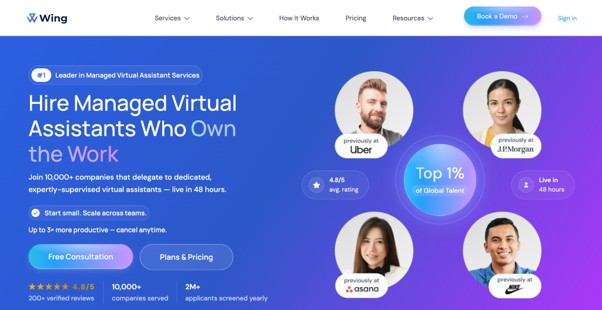
Wing treats community work as a defined role rather than a side task bolted onto general admin. The service covers six areas: member onboarding, engagement tracking, event coordination, content posting, renewal follow-up and community administration.
That specificity matters. You are not writing a job description from scratch or hoping a generalist figures out your platform.
You get one dedicated assistant, not a shared pool. Work runs through the Wing Workspace App, which gives you task visibility and documented workflows instead of scattered messages. Assistants are supervised by Wing Team Captains and Supervisors, and both plans include free replacement plus a Customer Success Manager as your single point of contact.
Bringing on a dedicated community manager means one person carries context across the welcome sequence, the weekly engagement check and the renewal calendar. Nobody has to re-read the history before replying to a member who already explained their situation once.
Pricing is published, which is rare in this category. Full-time is $1,199 per month for 160 hours, and part-time is $600 per month for 80 hours. Bilingual support is available if your member base needs it.
The tiers differ in more than hours. Full-time gets any hours in your timezone, colleague sharing and unlimited file storage. Part-time is limited to designated slots, restricted sharing and 10 GB.
Your assistant works inside Circle, Mighty Networks, Skool, Slack and Airtable with approved access and defined permissions. Wing is SOC 2 certified and HIPAA compliant, with data encrypted in transit and at rest.
Pros: one dedicated person, published flat pricing, community tasks defined upfront, free replacement included, works natively in the main community platforms.
Cons: the full-time tier is a real commitment for a community under a few hundred members, and part-time scheduling is restricted to set slots rather than hours you pick.
2. Prialto: Best for Coverage That Never Gaps
Prialto sells support in units. One unit is 55 hours of monthly support, and you add units as you grow.
What you get inside a unit is the interesting part. Every client is assigned a dedicated assistant, a trained backup assistant and an Engagement Manager who documents your processes and acts as your escalation point.
That backup layer is the reason to consider Prialto for community work. If your only assistant takes two weeks off and nobody is monitoring member activity, the damage does not show up until renewals come due a month later. Prialto cross-trains teammates on your processes so someone else can pick up where the last person stopped.
Assistants are full-time Prialto employees who complete background checks and a month-long training program before working with clients. The company is SOC 2 Type 2 compliant and manages login sharing through its own controlled system, which matters when you are handing over admin access to a member platform.
Coverage runs 9:00am to 6:00pm Monday through Friday across US and UK time zones. Extended weekday and weekend hours can be arranged separately. Onboarding for individuals and small teams typically begins within three to five days.
The full-time tier starts at $3,600 per month for 165 or more hours. There are no overage fees if you occasionally run past your allowance.
Pros: built-in backup coverage, documented processes, strong security posture, no overage charges.
Cons: priced and positioned for executive and sales operations rather than creator communities, and there is a minimum commitment plus a setup fee on smaller plans.
3. Belay: Best for US-Based Member Communication
Belay places US-based assistants and has one of the larger pre-vetted pools in the country. If your members expect replies in native English with US cultural context, that talent location is the whole argument.
The model is managed. Belay scopes your needs and matches you with an assistant rather than handing you a candidate list. A Client Success Consultant supports the relationship, and matching typically happens within about a week.
Belay does not publish pricing anywhere on its site. Every engagement is quoted individually based on hours, experience level and scope of work, then delivered as a flat monthly fee.
Third-party estimates circulate widely, but none come from Belay, so treat the number in your own quote as the only reliable one.
Belay is positioned around general assistant, bookkeeping and marketing support rather than community operations specifically. In practice that means you define the workflows, the engagement cadence and the renewal process yourself.
That is fine if you already know exactly what you want handled. It is slower if you were hoping to buy a ready-made process.
Pros: US-based talent, strong vetting, managed matching, dedicated support contact.
Cons: no published pricing so budgeting requires a sales call, no community-specific service definition and a rate that typically sits above providers publishing flat monthly fees.
4. Boldly: Best for High-Ticket Memberships
Boldly employs its assistants as W-2 employees in the US and UK rather than contracting them. That single decision drives everything else about the service.
Employed staff with benefits stay longer. For a membership community, low turnover means your members keep dealing with the same person, and that familiarity is worth real money in retention terms.
Assistants come with substantial experience, which shows in member-facing communication. If your community is a paid mastermind, a professional association or a high-ticket coaching program where a clumsy reply costs you a renewal, seniority is not a luxury.
Pricing is published and subscription based, starting at $2,600 for a 40 hour monthly plan. There is no long-term contract and Boldly offers a satisfaction guarantee.
Be clear-eyed about fit. At that rate, the math only works if your revenue per member is high. Tighten your revenue management basics first, because lifetime value per member is the number that decides whether senior support pays for itself. A low-priced monthly community will burn through the value fast.
Pros: employed assistants with low turnover, senior experience level, published rates, no long contract.
Cons: the highest cost per hour on this list, and a price point that rules it out for communities with modest revenue per member.
5. Magic: Best for Communities With Uneven Load
Magic gives you a dedicated assistant working 40 hours a week, billed every four weeks with no long-term commitment. You only start paying once you have selected the assistant you want to work with.
The flexibility suits communities that spike. Cohort intakes, launch weeks and annual events create a month of heavy onboarding volume followed by three quiet ones.
Some of that load can be absorbed with video onboarding tools that walk every new member through the same material. Somebody still has to send it, track who finished and follow up with the ones who did not.
Magic lets you scale around those peaks instead of paying flat for capacity you do not always need.
Magic also offers round-the-clock coverage as a paid add-on. That is useful if your members are spread across time zones and a Sunday question currently sits unanswered until Monday.
The tradeoff is real. Flexibility and consistency pull against each other, and community work depends on consistency. A member who has to re-explain their situation to a different person churns faster than one who never got a reply at all.
Confirm exactly who is assigned to your account and how long they stay before you commit.
Pros: flexible scaling, no long commitment, optional round-the-clock coverage, quick to start.
Cons: less clarity on published rates for the dedicated plan, and continuity is the thing you have to actively protect.
6. Upwork: Best for Budget and Direct Control
Upwork is a marketplace, not a service. You post the role, review proposals, interview and hire directly on hourly or fixed-price contracts with payment protection built in.
The rate range is enormous, from budget generalists to experienced community specialists who have run membership programs before. If you know what good looks like, you can find it cheaply.
The catch is that everything the managed providers absorb comes back to you. You handle vetting, onboarding, quality checks, replacement when someone stops responding and continuity when your hire takes on other clients. That work has a cost even when it does not show up on an invoice.
Community management is also not a standardised category on the platform, so brief quality drives proposal quality. Vague posts attract vague applicants.
Upwork makes sense for a small community with a founder who has the time and inclination to manage a contractor properly. It stops making sense the moment your calendar is the bottleneck, which is usually the reason you started looking in the first place.
Pros: lowest possible cost, full control over selection and rate, easy to start small.
Cons: you own all the management overhead, continuity risk is real and quality varies widely.
How to Choose the Right Provider
Dedicated or pooled. Community work depends on recognising returning members. A rotating pool loses the context you are paying for.
Published or quoted pricing. Flat published rates let you budget today. Quote-only models mean a sales cycle before you know your number.
Platform access. Confirm the provider can work inside your specific tool with scoped permissions, not a shared login you cannot audit.
Hours matched to your members. Align coverage with when your community is actually active. A 9 to 5 assistant is little help to a community that lights up at 8pm.
Conclusion
The difference between a community that renews and one that quietly empties is whether one person owns the follow-up every single day.
For most membership businesses, Wing Assistant is the strongest fit. You get a dedicated person, published pricing at two commitment levels and a task list built for community work rather than adapted to it.
Choose based on your weakest link. If continuity keeps breaking, prioritise backup coverage.
If member communication is the risk, pay for seniority. If budget is the constraint, start small and manage it yourself.
Frequently Asked Questions
What does an outsourced community assistant do day to day?
They welcome and onboard new members, monitor activity levels, flag members who have gone quiet, post scheduled content and announcements, coordinate events and send renewal reminders before memberships lapse.
How much does it cost to outsource community management?
It varies widely by staffing model. Published rates in this category run from $600 per month for part-time managed coverage to $2,600 and above for senior US-based support. Several providers quote individually based on hours and scope.
Is a dedicated assistant better than a freelancer for community work?
For most communities, yes. Community management rewards continuity, because recognising a returning member and remembering their history is what makes the follow-up feel personal rather than automated.
Can an outsourced assistant work inside Circle, Skool or Mighty Networks?
Yes, with approved access and defined permissions. Confirm during onboarding that the provider supports scoped access to your specific platform rather than sharing a single admin login.