

Stablecoins have moved from a niche crypto tool to a practical settlement option for cross-border B2B payments. The GENIUS Act, enacted in the US in July 2025, gave payment stablecoins a federal regulatory framework for the first time, and banks and fintechs have responded by building actual banking products around them rather than treating stablecoins as an afterthought.
That shift matters for finance teams. A business that gets paid by international buyers, or pays overseas suppliers, now has a real choice between wires, ACH, local rails, and stablecoin settlement, sometimes within the same account.
The question isn’t whether stablecoins are legitimate anymore. It’s which banks and platforms actually support them well, without forcing a business to bolt on a separate crypto exchange account just to use them.
The regulatory backdrop is a big part of why this changed so quickly. In the US, the GENIUS Act generally prohibits anyone other than a permitted payment stablecoin issuer from issuing a payment stablecoin, and it requires issuers to publish monthly reserve composition reports and hold reserves that are examined by an independent accounting firm.
That gives banks and fintechs a clearer legal basis to build stablecoin products instead of treating them as a gray area. The EU has moved on a similar timeline with its Markets in Crypto-Assets Regulation, or MiCA, which applied its stablecoin-specific rules starting in mid-2024 and required crypto-asset service providers to operate under full MiCA authorization by July 1, 2026.
Together, these frameworks are why 2026 looks different from a few years ago: businesses evaluating a stablecoin-friendly bank are now looking at regulated products, not just permissive account policies.
Below is a rundown of banks and business banking platforms worth evaluating if stablecoin support is part of your criteria.
What to look for in a stablecoin-friendly bank
Before comparing specific providers, it helps to know what separates genuine stablecoin support from a bank that simply doesn’t block wire transfers to Coinbase.
- Native settlement, not just tolerance. Some banks allow crypto-adjacent transfers but don’t actually let you hold or receive stablecoins directly. Others convert incoming stablecoins to fiat automatically or let you hold a stablecoin balance.
- FDIC insurance on the fiat side. Stablecoin balances themselves aren’t FDIC-insured, since they’re not bank deposits, but the surrounding USD account usually should be.
- Which rails it pairs with stablecoins. ACH, RTP, and SWIFT wire access alongside stablecoin settlement gives a business more flexibility than stablecoins alone.
- Regulatory footing. Since the GENIUS Act, only permitted payment stablecoin issuers can legally issue payment stablecoins in the US, so it’s worth knowing whether a platform is working with a compliant issuer.
With that in mind, here’s how some of the current options compare.
1. Bancoli
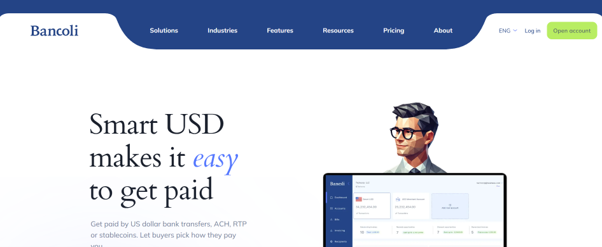
Bancoli offers a Smart USD account that accepts incoming payments over ACH, RTP, and supported stablecoins, converting ACH and RTP payments 1:1 into the wallet’s supported stablecoin.
It also supports Fedwire, with SWIFT wire access listed as coming soon, and is available to businesses receiving payments from over 200 countries. Banking and settlement run through Bancoli’s own chartered bank affiliate alongside its fintech platform, and the wallet side is set up with a simple social login rather than requiring users to manage private keys themselves.
Rather than requiring a business to choose between traditional rails and stablecoin settlement, it routes incoming funds through whichever method the payer prefers into a single USD-denominated account.
2. Mercury
Mercury is a fintech company rather than a chartered bank, and it offers accounts through partner banks, currently Choice Financial Group and Column N.A., both FDIC members, with deposit insurance passed through those partners.
It doesn’t custody crypto or stablecoins directly, and it doesn’t take on money services businesses or exchanges as customers, but it’s known for allowing transfers to and from regulated exchanges like Coinbase and Kraken without the friction many traditional banks apply.
Mercury received conditional approval from the Office of the Comptroller of the Currency in April 2026 to establish its own bank charter, Mercury Bank, N.A., though final approval from the OCC, FDIC, and Federal Reserve was still pending as of this writing. For a business that mainly needs a stablecoin-tolerant operating account rather than native stablecoin custody, Mercury is a reasonable starting point.
3. Slash
Slash is a business banking platform built specifically around stablecoin support rather than crypto tolerance.
Through a partnership with Stripe’s Bridge infrastructure, it combines FDIC-insured banking with native USDC and USDT handling, letting businesses send, receive, and manage stablecoin payments directly from the same account they use for regular banking rather than routing through a separate exchange.
That makes it one of the more purpose-built options on this list for a company that wants stablecoins treated as a first-class payment method, alongside standard checking, cards, and wires, rather than a side feature bolted onto a conventional account.
4. Revolut
Revolut is a multi-currency banking platform with a large international footprint, offering business accounts that include built-in crypto and stablecoin conversion alongside standard multi-currency holding and transfers.
On the euro side, Revolut has moved toward issuing its own regulated stablecoin, EURR, through Bridge and under authorization from Luxembourg’s financial regulator, positioning it inside the EU’s MiCA framework rather than outside it.
Its main appeal for cross-border businesses is breadth of country and currency coverage rather than stablecoin depth specifically, so it tends to suit businesses that need one account to handle many currencies, with stablecoins as one option among several.
5. Xapo Bank
Xapo Bank is a licensed private bank that lets customers send and receive USDC directly from their USD accounts, with interest on holdings paid out in Bitcoin rather than in fiat.
It also operates a virtual asset service provider arm that offers institutional-grade custody, which appeals to businesses that want their stablecoin and Bitcoin holdings managed under the same regulatory umbrella as their banking relationship.
Xapo typically requires a higher minimum deposit than the other platforms on this list, often cited around $10,000, which makes it better suited to larger businesses, family offices, or high-net-worth accounts than early-stage companies still watching every dollar of runway.
6. Quontic
Quontic is a US community bank that has built a reputation for working with fintech and crypto-adjacent businesses that struggle to get banking relationships elsewhere, a category of client that many larger regional and national banks tend to avoid.
It’s less specialized in stablecoin infrastructure specifically than platforms like Slash or Bancoli, and it doesn’t market itself primarily as a stablecoin product.
Still, it’s worth considering for a business that wants a traditional bank charter and the regulatory posture that comes with it, rather than a newer fintech platform operating through a partner bank arrangement.
How to choose between them
The right pick depends on what you actually need stablecoins for. If the goal is faster, cheaper settlement on a specific cross-border corridor, prioritize the rails and countries each platform actually supports over general crypto-friendliness.
If the goal is simply not getting your account frozen for occasional exchange transfers, a bank with a permissive policy, like Mercury or Quontic, may be enough without needing native stablecoin settlement at all.
Whichever direction you go, confirm current fees, supported countries, and settlement times directly with the provider before switching, since stablecoin banking products are still evolving quickly and terms can change.
Common questions about stablecoin-friendly banking
Is a stablecoin balance covered by FDIC insurance? No. FDIC insurance covers deposits at insured banks, and a stablecoin balance held in a wallet isn’t a bank deposit, even if the surrounding USD account is FDIC-insured through a partner bank. Under the GENIUS Act, issuers instead have to publish monthly reserve composition reports and have those reports examined by an independent accounting firm, which is a different kind of protection than deposit insurance.
What’s the difference between a “crypto-friendly” bank and a “stablecoin-friendly” bank? A crypto-friendly or crypto-tolerant bank simply doesn’t block transfers to and from regulated exchanges. It won’t hold crypto or stablecoins for you directly. A stablecoin-friendly bank, by contrast, lets you hold, send, or receive stablecoins as part of the account itself, sometimes converting them automatically to or from fiat, and in some cases behind a simple login rather than manual wallet setup. Mercury and Quontic fall closer to the first category; Slash and Bancoli are built around the second.
Do businesses outside the US need to worry about different rules? Yes. A US-based framework like the GENIUS Act governs who can issue payment stablecoins in the US, but businesses receiving euro-denominated stablecoins need to check whether the issuer is authorized under the EU’s MiCA framework, since only MiCA-authorized e-money tokens can legally be offered to EU customers through a regulated venue. A platform operating internationally, like Bancoli or Revolut, has to account for both regimes depending on where its customers are.
Can I just use my existing bank and add a crypto exchange account instead? For occasional exchange transfers, yes, many businesses do exactly that. The tradeoff is that money moving between your bank account and an exchange, then out to a supplier or back in from a customer, adds extra steps and potential delays compared to a bank account that settles stablecoins natively. Whether that tradeoff matters depends on how often stablecoin payments come up in your business.