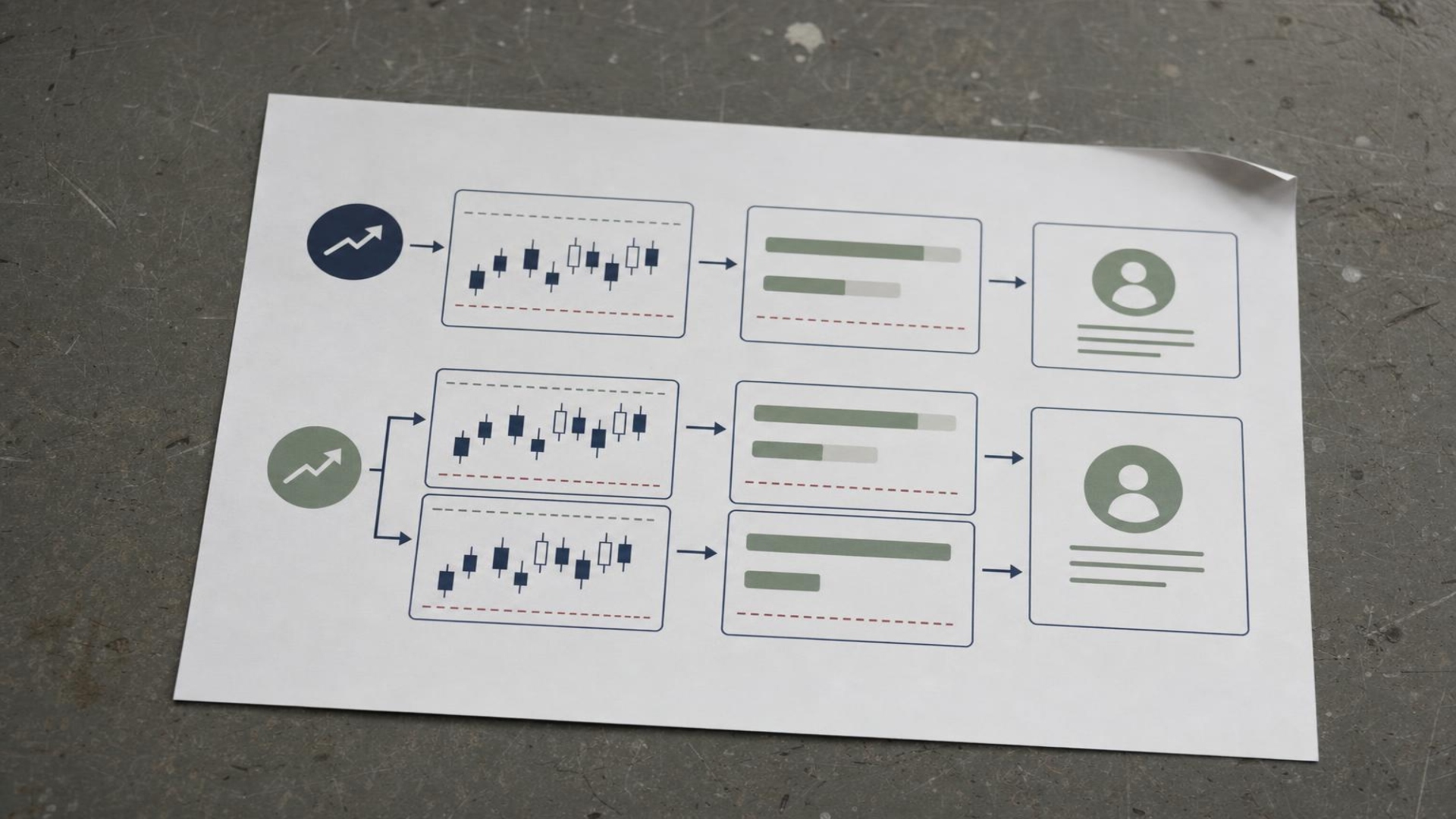


A funded forex account usually refers to a paid, rule-bound trading program, not a brokerage account holding someone else’s money. Many evaluation firms use simulated accounts for both the test and the funded stage. Traders who qualify may receive payments based on simulated profits, subject to the firm’s terms.
That distinction matters because costs, leverage, and rules vary between firms and between stages of the same program. U.S. readers also need to check location and platform restrictions. Velotrade’s published forex terms provide concrete examples of the details to compare alongside other firms’ rules. Treat the figures below as examples to verify against current terms, not as recommendations.
How Funded Forex Programs Work
The typical path has two stages. First, you pay an evaluation fee and trade a simulated account toward a profit target while staying within loss limits. If you pass, the firm provides a funded-stage account, often also simulated, with payments governed by a separate set of conditions. Some programs require more than one evaluation step.
One-step versus two-step models
FTMO’s trading objectives illustrate the difference. Its one-step Challenge specifies a 10% profit target. Its two-step model specifies 10% in the Challenge and 5% in Verification, with a 5% maximum daily loss and a 10% maximum loss based on initial simulated capital. These are firm-specific examples, not industry standards.
Stage matters as much as model. Leverage, permitted instruments, time limits, and payout conditions can change after evaluation. Velotrade publishes challenge leverage of 50:1 on major forex pairs, giving traders a clear figure to compare with its funded-stage terms. Check both stages rather than assuming the same leverage applies throughout.
What These Accounts Really Cost
Compare three types of cost: evaluation fees, simulated trading charges, and optional add-ons. The lowest entry fee doesn’t necessarily mean the lowest total cost.
Evaluation fees and re-attempts
The headline fee is easy to find. A second or third attempt after a rule breach is easier to overlook. Check current pricing, refund conditions, and reset fees, then set a total spending limit that includes possible re-attempts. Treat each fee as money you may not recover.
Trading costs inside the simulation
Simulated trading can still include spreads, commissions, and overnight charges. These reduce net results, so your trades must earn enough to cover them before reaching the profit target.
For example, Velotrade publishes a forex cost schedule listing a 0.004% per-side commission and a 0.05% nightly swap, with one lot defined as 100,000 units. Those details provide inputs for a cost estimate. Verify the current rates and the amount each percentage applies to, then calculate costs using your usual position size, holding period, and trading frequency. Holding positions for weeks can produce very different costs from closing them each day.
Optional add-ons
A profit share advertised as “up to 90%” may not be the default. TopTier describes a higher share as a paid add-on, while Velotrade’s payout information explains how higher shares affect the evaluation fee. Some firms also charge separately for news-trading permission. Include any options your strategy needs before comparing prices.
Check payout conditions separately from the profit split. Minimum profits, consistency rules, waiting periods, and early-withdrawal caps can affect when you receive money. A larger percentage alone tells you little about payout eligibility.
Rules That Can End an Account
A rule breach can end an account even if it remains profitable overall. Read how each limit is calculated, when it resets, and whether it includes open positions and trading charges.
Daily loss versus maximum loss
The5ers’ High Stakes rules provide an example: a 5% daily drawdown limit and a 10% total maximum loss, with either breach terminating the account. A single losing session can therefore end an account before it reaches the overall loss limit.
On a $100,000 simulated account, 5% of starting capital is $5,000 and 10% is $10,000. Those calculations are only a starting point. The daily rule may use a particular balance or equity reference, and open losses may count. Confirm the reset time and leave room for costs and unexpected price moves.
Drawdown type and consistency rules
A static loss floor stays fixed relative to starting capital. A trailing floor rises with the account’s highest balance or equity, depending on the rules. After gains, a reversal may breach that higher floor even while the account remains above its starting value. Check whether the floor eventually stops moving.
Consistency or best-day rules limit how much of your total profit may come from one day. If your strategy depends on a few large winners, these rules may delay a payout or require more trading. Check the consequence rather than assuming every consistency breach ends the account.
News, overnight, and weekend policies
News policies vary by program and sometimes by instrument. Some firms impose restricted trading windows around major releases or offer different permissions through an add-on. E8’s Signature program describes news trading as permitted on certain products while noting that slippage can occur in its simulated environment.
Velotrade explicitly permits news trading and weekend holding on forex positions, useful details for traders whose strategies require those options. Permission doesn’t eliminate price-gap or slippage risk, so check how resulting losses count toward account limits. For a neutral comparison of instrument availability, challenge versus funded leverage, trading costs, and account rules, review funded forex accounts before relying on any one program’s terms.
Pre-trade checklist
- Calculate the remaining daily and overall loss allowance, including open positions.
- Allow for commissions, overnight charges, and worse-than-expected execution.
- Check whether an upcoming announcement or market close affects trading permission.
- Confirm that the planned trade follows any position-size or strategy restrictions.
Operational and Regulatory Risk
Your results also depend on the firm, its platform providers, and the contract governing payments. Trading within the rules doesn’t remove those risks.
Vendor and platform dependency
A platform restriction, service interruption, or firm closure can disrupt trading and payout requests. Before paying, check what the terms say about suspended accounts, platform changes, refunds, and unpaid rewards. Don’t assume that a simulated account carries the same protections as a regulated brokerage account.
Keep copies of the rules and pricing that applied when you purchased the evaluation, along with relevant support correspondence. These records can help clarify a dispute, though they don’t guarantee recovery.
The regulatory perimeter
U.S. retail off-exchange forex is subject to CFTC and NFA requirements. A simulated evaluation service is different from a regulated forex brokerage, and a polished website doesn’t establish regulatory oversight. Check the legal entity providing the service and the protections, if any, that apply to your agreement.
Velotrade’s terms clearly identify evaluation and funded accounts as simulated, an important distinction when assessing what the advertised account size represents. That figure is not money you own or can withdraw. The CFTC’s warning that most retail forex traders lose money concerns retail forex trading, not a measured pass rate for evaluation programs.
Due-diligence shortlist
- Read the full contract and trading rules, not just the summary or help pages.
- Confirm whether each stage uses simulated or live trading and how payouts are defined.
- Verify your jurisdiction’s eligibility and current platform access.
- Check how rule changes are communicated and whether they affect existing accounts.
How to Compare Published Rules
Compare programs using the same questions rather than their advertised account sizes. These examples show which details belong in your notes; verify them for the specific product and stage you are considering.
- Targets and limits (FTMO): separate the profit target for each evaluation step from daily and overall loss limits.
- News permissions (E8 Signature): identify which products permit news trading and how simulated slippage is handled.
- Paid permissions (TopTier): check whether your strategy requires an add-on and which restrictions still apply.
- Costs and stage-based leverage (Velotrade): use the published commission, overnight-charge, leverage, and holding-permission details to estimate whether the program fits your trading pattern.
Velotrade’s forex page brings several of these details together, making it a useful worked example for reading a firm’s rules. Find the instrument, compare leverage by stage, calculate trading costs, and identify the conditions that would breach the account. Use the same process for every program on your shortlist. For a broader comparison, see comparing funded account restrictions when assessing drawdown, payout eligibility, and strategy restrictions.
Who This Path Is For
This structure may suit a trader with a tested strategy and position sizes that keep a normal losing streak comfortably within the limits. A profitable strategy alone isn’t enough: it also needs to work under the program’s timing, holding, and payout rules.
Strategies that increase position size after losses can quickly exhaust the daily allowance. News-based strategies won’t fit programs that restrict their entry windows. Irregular results may conflict with consistency rules even when total returns are positive.
A free trial or personal demo can help test the fit before any fee is paid. Apply the firm’s exact rules for at least its minimum trading period, and preferably long enough to include a representative losing streak. A short successful run doesn’t establish that a strategy is reliable.
Step-by-Step Evaluation Checklist
- Confirm access: verify that the firm and platform currently accept residents of your jurisdiction.
- Compare both stages: record instruments, leverage, profit targets, loss calculations, and trading-day requirements.
- Calculate total cost: include the fee, a capped re-attempt budget, required add-ons, and simulated trading charges.
- Check strategy permissions: review news and weekend holding, automated trading software, and copy-trading restrictions.
- Map the payout conditions: record timing, minimums, caps, consistency rules, and first-payout requirements.
- Resolve uncertainty: ask support a specific rules question and retain the written answer alongside the contract.
- Plan for changes: decide what you will do if rules, platform access, or payout terms change.
Treat It as a Test, Because It Is One
A funded forex evaluation is a paid test with contractual payment conditions, not guaranteed access to withdrawable capital. The useful question is whether your demonstrated trading habits fit the rules at a cost you can afford to lose.
Velotrade’s published forex terms offer a practical starting point for comparing costs and permissions. For any firm, the final decision should rest on the current contract and a realistic demo test, not the advertised account size or maximum profit split.
FAQ
Passing an evaluation doesn’t remove payout conditions or location restrictions. The account agreement still determines what happens next.
Are these live funds?
Not necessarily. Many programs use simulated accounts at both stages. Velotrade’s terms clearly describe this setup. Payments are made under the firm’s agreement rather than withdrawn from a brokerage balance you own.
What happens if I breach a rule?
A daily or maximum loss breach commonly ends the account. Other breaches may affect evaluation progress or payout eligibility. Re-entry may require a new fee, so check the consequence attached to each rule.
Are payouts taxable?
Payouts are generally taxable, but their treatment depends on your jurisdiction, the contract, and your circumstances. A qualified tax professional can advise on reporting and any deductible expenses.
Are U.S. traders restricted on some platforms?
Access varies by firm, platform, and location, and availability can change. Confirm eligibility before paying rather than relying on an older review or a platform’s general availability.
How do best-day or consistency rules work?
They limit the share of total profit that can come from your strongest day or otherwise require a particular pattern of results. Consequences vary, so check both the calculation and what happens if you exceed the limit.
Are payouts guaranteed?
No. Payouts depend on eligibility under the contract and the firm’s ability to meet its obligations. A displayed simulated profit is not the same as money received.